Kitchens6 min read
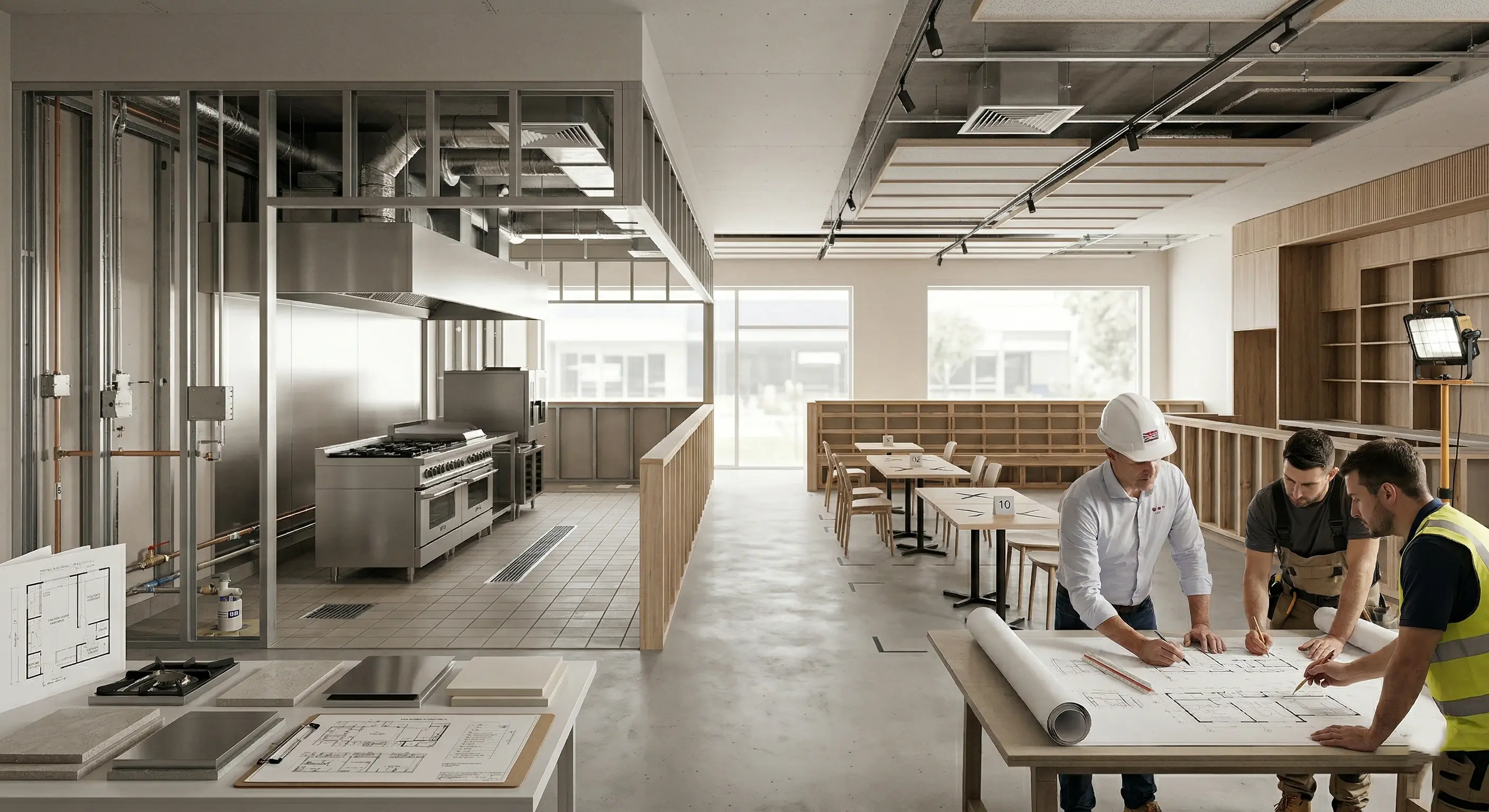
A restaurant fit-out is unlike any other commercial construction project. Health codes, hood exhaust systems, grease traps, and floor drains make it a specialized discipline. Here is the complete picture.
A restaurant or food service fit-out is among the most complex commercial construction projects available. It combines the mechanical demands of a commercial kitchen — exhaust systems, gas lines, fire suppression, grease management — with the customer-facing design requirements of a retail environment, all under the scrutiny of Alberta Health Services and Edmonton's Development and Building Approvals process. Getting any component wrong causes expensive rework, delayed opening, or failed inspections.
A restaurant fit-out in Edmonton requires multiple approvals from multiple agencies, running in parallel. A development permit confirms zoning allows a food service use at your address. A building permit covers all construction. A separate Alberta Health Services (AHS) food facility approval covers the kitchen layout, equipment specifications, handwashing station placement, and food storage arrangements. A fire suppression permit covers the commercial hood and Ansul system. An ATCO Gas permit covers all new gas lines and equipment connections. Missing any of these creates a chain of delays; a contractor experienced in Edmonton food service construction knows how to sequence these applications to prevent bottlenecks.
The commercial kitchen is the most technically demanding component of any restaurant fit-out. Exhaust hood systems for commercial ranges require custom-engineered makeup air calculations — the volume of air exhausted by the hood must be replaced by conditioned air, or the kitchen becomes an uncomfortable negative-pressure environment and the system does not perform properly. Floor drains must be placed under every piece of equipment that produces condensate or requires cleaning runoff. A grease interceptor (grease trap) is required by Edmonton's sewer bylaw for any commercial kitchen — it must be properly sized and accessible for servicing.
The front of house design drives revenue — and its principles overlap with retail design. Seating density must balance maximum covers with a comfortable experience; cramped seating destroys repeat business. Acoustic management is critical: loud restaurants lose customers who value conversation. A combination of material choices (carpet in portions of the floor, acoustic ceiling panels, sound-absorbing booth backs) manages reverberation without over-softening the ambient energy that makes a room feel lively. Lighting should be layered and dimmable — bright enough for lunch service, atmospheric for dinner.
Commercial spaces in Alberta must comply with the Alberta Building Code's accessibility requirements for barrier-free design. For restaurants, this means: accessible entrance with automatic door operator or minimal force door, accessible seating (5% of total seating minimum at accessible table heights), accessible washrooms (typically at least one fully accessible washroom is required), and accessible path of travel throughout the public area. These requirements are non-negotiable and are verified at inspection.
A restaurant fit-out that is properly resourced and planned from the start takes 12–20 weeks from permit issuance to opening for a full build, and 8–14 weeks for a change-of-use fit-out in an existing food service space. These timelines assume permits are issued promptly, equipment is ordered before construction starts, and AHS plan review is initiated early. The single most common delay in restaurant projects is late equipment ordering — commercial kitchen equipment has lead times of 6–14 weeks. Equipment orders must happen during the design phase, not after construction starts.
A restaurant is not just a renovation — it is the infrastructure for a business. The construction phase sets the ceiling for what is operationally possible for the life of the lease. Plan it accordingly.
— Aarth ConstructionLet's build something extraordinary together.